Showing posts with label HARDWARE. Show all posts

Monday, May 11, 2015

Corsair H100i GTX review

Taking AIO Liquid cooling to your GTX performance level

Corsair H100i GTX review
We ensure that you review the innovative Corsair Hydro Series H100i GTX Series Liquid cooler. An all-in-one liquid CPU cooler for cases with 240mm radiator mounts. This updated revision CPU cooler is compatible with Corsair's LINK software. This enables you to program, customize and monitor this all-in-one liquid cooling solution on your processor. Armed with two SP120L PWM fans as well as a nice 240mm radiator the performance must be really good, along with Corsair's LINK integrated, it is possible to monitor temperatures, adjust cooling performance and customize LED lighting completely from your desktop.

You know, on earth of CPU coolers nothing ever stops developing. These days you may pick a hundred different heatpipe based coolers, where many are shaped, formed and priced exactly the same. The better heatpipe based coolers are wonderful though. Next in line are LCS systems (liquid cooling), the basic products are affordable, very easy to install pre-fab liquid cooling kits. We've seen and tested a lot of them as Corsair, Asetek, CoolIT etc all have interesting kits.

The bigger dilemma is cooling performance. The gear behind these kits are perfect yet the performance is usually battling a smaller included 120mm radiator with thin tubing and lacking coolant levels on account of missing reservoirs. To compensate FAN RPM comes up making a good-looking product noisy again. With that in mind Corsair did start to develop a new H series (for Hydro) coolers.

The product we test in specific could be the Corsair H100i GTX, an updated design with new cooling block and regulated control for pump and fans. Next to that what's interesting is the product is based on a 240mm radiator giving it a large amount of cooling expanse. It is a cooler series that is certainly easy around the eyes and has an relatively tool free installation. Next to some really good performance, the Corsair H100i GTX is compatible with Corsair's LINK software. You get together the LCS unit towards a USB port and so the software lets you program, customize and monitor this very easy to install Liquid Cooling solution. And hey inside new RGB concept, the brand at the top of the water-block could be configured with a color of your choice.

So without further ado, let's possess a peek on the Hydro Series Corsair H100i GTX and after that head onwards in the review.

Features


Corsair announced the all-in-one Hydro Series GT and GTX, the company’s most sophisticated liquid CPU cooler, as well as a new Hydro Series HG10 N780 Edition GPU cooling bracket for NVIDIA GeForce 700 Series graphics cards. Actually three products are actually launched recently, here an instant overview.
The Hydro Series H100i GTX liquid CPU cooler pairs two 120mm fans that has a 276x125x30 millimeter radiator to supply CPU cooling inside the most processor-intensive applications or quiet operation if your PC is idle. The H110i GT also incorporates a new generation, high-efficiency cooling block that has a striking facelift with logo inserts on the market and radiator. Integrated Corsair Link support provides monitoring and customization of built-in logo lighting, fan speed, pump speed. As with all Hydro Series CPU coolers, the H100i GTX is very self-contained, requires no maintenance or filling.
  1.     276mm x 125mm x 30mm aluminum radiator
  2.     Two SP120L 120mm high static pressure fans
  3.     Corsair Link support for customization and monitoring
  4.     Sleeved wide diameter, low evaporation rubber tubing
  5.     Support for Intel LGA 115x, 1366, 2011 and AMD AM2, AM3, FM1, FM2
  6.     5-year limited warranty
  7.     MSRP: $109.99

The included fans are custom-designed for high static pressure air delivery with minimum turbulence and noise. They’re PWM controlled, so that you can customize the fan speed to get the optimal balance of cooling and noise.


Package contents
  1.     Hydro Series H100i GTX Liquid CPU Cooler
  2.     Mounting kit for many modern CPU sockets
  3.     Two SP120L High Torque 120mm Fans
  4.     USB cable for Corsair Link Integration
  5.     Fan and radiator mounting screws
  6.     Thermal compound (pre-applied)
  7.     Quick Start Guide

Compatibility
  •     Intel LGA 1150, 1155, 1156, 1366, 2011 and 2011-3
  •     AMD sockets FM1, FM2, AM2, and AM3

Technical specifications
  1.     Radiator dimensions: 276x125x30
  2.     Fan dimensions: 120mm x 25mm
  3.     Fan speed: 2100 +/- 10% RPM
  4.     Fan airflow: 113 CFM
  5.     Fan static pressure: 3.99mm-H2O
  6.     Noise level: 43dB(A)


"The user-selectable fan control and Corsair Link Digital compatibility gives performance enthusiasts the energy to customize their cooling performance and manage fan noise by deciding on the amount of cooling they require," concluded you can actually rep. A quick search shows prices of roughly 125 EUR to the H100i GTX here within the Netherlands. But let's check out the product, in depth.


Final words and conclusion


Much much like the H110i GT this H100i GTX is showing more muscle when compared with its predecessor, it can do show excellent performance with regard to cooling - specifically in overclocked conditions. As you have had the capacity to notice in the results, we started by using a new test-platform that's more representative anno 2015. The reality remains which the Core i7 4970K is definitely such a nasty processor to cool down. Regardless we must build is a result of scratch again and more than time more comparative results are going to be added. The new test platform uses the Core i7 4790K and that we test it within a default setup (clocks) and overclocked at 4600 MHz with 1.3 Volts. Now the 1.3 Volts is just not needed for the overclock, 1.2 Volts would have been sufficient as well. However we inject more voltage to discover how the cooler behaves, and that we know with certainty that a great many of you are overclocking your 1.3 Volts. That does however convert it into a tough task for any cooler to manage.

We are actually pleasantly surprised from the Corsair H100i GTX, the cooling performance is basically nice and on par with high-end cooling, cooling capacity is unquestionably impressive with obviously any good proper overclock.

Aestethics & Design


The overall looks are certainly tasteful in terms of I am concerned, a completely black design using the subtle shades of grey allow it to become an appealing product towards the eyes. It is easy to install with all the mounting system, and factory filled up with coolant in the closed loop. The black design is likely to make this kit look nice in any PC. It simply is an excellent alternative to heat-pipe coolers using the added benefits for being fairly quiet whilst offering pleasant looks. No skills are important other than the necessity for ten minutes to set up the kit. Added benefit should you use LINK is perhaps you can change the hue of the Corsair logo embedded in to the cooling block, to the RGB color. We can visualize that with an ASUS ROG themed motherboard you'd change that to red, perhaps orange or green through an accompanying Gigabyte motherboard along with perhaps yellow by having an MSI XPower series motherboard. As subtle as that LED is, it truly does bring a 'finished' feel on your final PC build and color theme.


Pricing


The Corsair H100i GTX will likely be introduced at 119 USD. We expect roughly similar prices inside EU, but that will depend on the VAT with your country along with the USD to EURO differential. I think it's really a fair sum of cash as this cooler offers tremendously. It is silent (if kept at default settings), at the default settings it really offers fabulous cooling performance. The extra bonus is found inside the LINK functionality also as the RGB lighting system. But make no mistake, the performance and features are perfect for a 240mm rad based product as of this price level. Let me also remind you that you could easily spend 200/300 EUR on tubing, radiators, cooling blocks, reservoirs etc.

It's pretty cool ....

I haven't any hesitation recommending you the Hydro series Corsair H100i GTX, it is a darn good performing product with nice looks, thick sleeved tubing plus the comfort of RGB color selection. If we solely zoom in at performance then for the AIO kit this is one of the better performing ones available and in its default configuration it remains as a very silent product. The product is quite user friendly to fit and joined with its apperance and nice performance may buy a product that's spot on money wise. You'll have an abundance of extra ability to overclock. If you are thinking about the temperatures you have often seen at 1.3 Volts, well remaining under 70 Degrees C using a Haswell processor in this class is nice. You will likely n't want 1.3V for 4400~4600 MHz. Overall the cooler manages really well while using tested Core i7 4790K processor we fired off in internet marketing, as well as if you need 1.30 Volts; the idea will offer enough cooling performance and this remains a troublesome task for any cooler. A small additional bonus may be the LED lit Corsair logo which you'll want to color to the RGB preference with all the help of LINK software. LINK itself is something which belongs inside category either hate or love, nothing is in-between. But hey it is an option that lets you monitor and customize your cooling, this is a plus in our books.  The one remark I have to make is always that there is a fair level of wires leading out and in to the cooling block. So design wise there's more cable spaghetti clutter to handle.

Overall one more words might be short, we shall recommend the Corsair H100i GTX with no hesitation. The cooling performance is quite good for a program of this class, combined with all the aesthetics, ease of installation plus the RGB coloring logo with LINK functionality we are able to recommended this puppy for certain.

Saturday, May 9, 2015

Noctua NH-L9x65 Low Profile CPU cooler review

Noctua NH-L9x65 Low Profile CPU cooler review
In today's review we shall look at the Noctua NH-L9x65 Low Profile CPU cooler, with 65 such as 65mm. These smaller than average and petit CPU coolers can be utilized with any style factor motherboard and CPU but give attention to Micro ATX and Mini ITX. They are small, deadly silent but do pack enough punch to even cool a Core i7 4790K. And yes, you can also overclock a little as well. Yup, that will be Noctua for ya.

You know, there really aren't bad performing coolers produced anymore. For every segment and budget you will find something you need. The market stabilized and in the entire range and scope of heatpipe based coolers you will find there's certain comfortable zone with a corresponding product available. As a result, the majority of coolers out there are all adequate at least. There are always exceptions for this, there exists a handful of manufacturers on the market that offer the really interesting stuff, the kit and gear that truly stand out from the cooling crowd, the hardware me and you crave and wish so badly... that may be in the enthusiast domain of gaming hardware. And that's where we should make a take a look at Noctua when they tick all of the boxes.

In their long distinct CPU coolers, Noctua recently introduced the L9-type coolers, especially created for the small form factor range The cooler has been introduced in to the channel to make available OK performance however its main focus is going to be silent according to small form factor PCs. The Noctua NH-L9x65 Low Profile CPU cooler is likely to keep any CPU released currently cooled including the most high-end Haswell SKUs.

Have a peek at the model tested, it would look a little bulky, but keep in mind that when I say this is a very small coolers. 

The Noctua Cooler


Noctua released its new NH-L9x65 low-profile cooler plus a 4-pin PWM version of the company's popular NF-A6x25 60mm fan. While the latter adds PWM support for automatic speed control towards the proven NF-A6x25 design, the NH-L9x65 is usually a taller, performance-enhanced version of Noctua's award-winning NH-L9 low-profile coolers.

"Our NH-L9 coolers have grown to be a default option for customers seeking premium grade quiet coolers inside sub-40mm class, though a height of only 37mm, their performance is inevitably limited", explains Mag. Roland Mossig (Noctua CEO), "The new NH-L9x65 supplies the increased performance essential to cool high-end CPUs quietly while still offering excellent case and component compatibility."

Due to its compact heatsink along with the renowned 14mm thin NF-A9x14 PWM fan, the NH-L9x65 stands only 65mm tall (the identical height as low-profile expansion cards), rendering it ideal for utilization in compact HTPCs or Small Form Factor cases that include limited clearance for CPU coolers. With 65 rather then 37mm height and four rather then two heatpipes, the NH-L9x65 is a lot more powerful than its smaller siblings yet retains their 95x95mm footprint, which guarantees 100% RAM and PCIe compatibility on Intel based ITX mainboards and helps make the cooler far easier to work with mainly because it doesn't overhang near-socket connectors.

Topped served by the professional SecuFirm2 multi-socket mounting system for Intel and AMD, Noctua's renowned NT-H1 thermal compound and 6 years manufacturer's warranty, the NH-L9x65 fuses everything users have arrived at expect from Noctua's larger coolers right into a compact premium package for space restricted systems.

Prices and availability


The new models are now shipping and are available shortly. The manufacturer suggested retail cost is as follows:
  •     NH-L9x65: EUR 44.90 / USD 52.90

The NH-L9x65 can be a taller, performance-enhanced version of Noctua’s award-winning NH-L9 low-profile coolers. With 65 rather than 37mm height and four as an alternative to two heatpipes, the NH-L9x65 is much more powerful than its smaller siblings yet retains their 95x95mm footprint, which guarantees 100% RAM and PCIe compatibility on Intel based ITX mainboards and definitely makes the cooler far easier to work with since it doesn’t overhang near-socket connectors. Thanks towards the highly optimised NF-A9x14 premium fan that supports fully automatic speed control via PWM, the NH-L9x65 runs remarkably quiet. Topped served by the professional SecuFirm2™ multi-socket mounting system for Intel and AMD, Noctua’s renowned NT-H1 thermal compound and 6 years manufacturer’s warranty, the NH-L9x65 fuses everything users have learned to expect from Noctua’s larger coolers to a compact premium package for space restricted systems.

Caution: The NH-L9x65 can be a highly-compact low-profile quiet cooler created for use in small form factor cases and HTPC environments. While it provides an awesome experience performance in their class, it's not suitable for overclocking and really should be used with pride on CPUs exceeding 84W TDP (Thermal Design Power). Please consult our TDP guidelines to determine whether the NH-L9x65 is suggested for your CPU.

Preparing the System Overclock


We'll consider the cooler in numerous system configurations/conditions. For the audiophiles amongst us your focus must be noise levels mostly. Then there is your normal non-overclocked mainstream usage therefore the performance enthusiast overclocking users. So with all the many variables at heart we'll be testing three things for your cooler.
  1.     dBA noise pressure levels
  2.     Temperature together with the CPU at default settings
  3.     Temperature together with the CPU at 4600 MHz with 1.3 Volts placed on the CPU

Mind you that every our tests are carried out at a room temperature of roughly 21 Degrees C. We decided to go with all the Core i7 4790K the way it literally could be the hottest processor your dollars can get you. You guys are all aware of that once overclocked with added voltage, the temperatures escape control big-time.

We've been battling the question whether or otherwise not to actually work with a Core i7 4790K on the Z97 motherboard. The Haswell processors all have poor heat transfer on the silicon die on the IHS. Fact remains that it CPU is really what the Guru3D audience buys -- and thus you -- may want to know how these coolers perform. We could likewise have used one thousand EUR 8-core Core i7 5960X processor but exactly how many people do actually purchase these processors? The vast majority of our readers will buy the Core i7 47x0 series -- so this is exactly what most of our readers are actually interested in hence we took the very best tier 4-core SKU -- it's only that Intel made things very complicated which has a rather poor heat transfer design.
So we'll be testing that processor at default clock frequencies, then we'll blast the processor with 1.30 Volts like shown above. That voltage isn't needed for 4600 MHz but typically will provide the processor having a non-performance heatpipe cooler towards 90 Degrees C (!). We are merely attempting to see how the cooler will behave under such stringent conditions. All temperatures reported will be the processor package sensor temps. The cores will independently differ slightly in Degrees C every now and then. We measure in an ambient room temperature of 21 Degrees C.

The CPU stresser


We test processor coolers carrying out a strict protocol. We have already shown you the BIOS settings to the overclock. To stress the CPU we apply the strain modes (default and OC 1.3V) and have absolutely our stress software wPrime finish the whole run twice. We however possess a security feature enabled, when a cooler reaches 98 Degrees C the machine will power right down to prevent it from damage.

Below, an illustration of this one of our test runs. We compose the package temperature, the per core temps as a result can differ occasionally. For LOAD testing we make a note of the MAXIMUM measured temperature from a two full wPrime 1000M runs. In the example below we employ a clock setting of 4600 MHz on all CPU cores which has a strict 1.3 Volts for the processor.

------------------------------------------------------------------------------------------------------------

Final words and conclusion


The Noctua NH-L9x65 is really a small form factor cooler and must be used as such. Our testing methodology and hardware used just isn't exactly what the Noctua NH-L9x65 function is for, hence the somewhat high temperatures. Obviously overclocking had not been an option in cases like this and circumstances.  That said, which has a lower spec processor things could consider looking much better, and again, small form factor ... think silent HTPCs here as that si the location where the Noctua NH-L9x65 shines. Given the size both coolers, it truly is hard to believe how well they with regards to noise though. I mean, this cooler is give or take 95x95mm possibly at default clock frequencies nevertheless can tame the beast be the Core i7 4790K well.


Aestethics & Design


Fot the Noctua NH-L9x65, the looks remain trivial. We stated often times that Noctua could really work with a change in their color scheme in regards to their products. The brown/beige colors simply are not consistent with today's high-end preferred and colored products. Despite the colors the end-users are prepared to look away, because the quality with the coolers are just too good, which matters more. Noctua, why don't you consider a black cooler with darker brown/beige fans? We do comprehend the dilemma accessible for Noctua though, Gigabyte uses Blue, ASUS ROG used Red with each company really has their unique house color design thereby trademark for company branding. Also achievable market growing, we might REALLY like to find out Noctua engage the AIO Liquid cooler segment, a location where they may be very popular using their low-noise and high quality fans.


Performance


Cooling wise it performed okay average at best, but perform need to mention that we armed our test system using the difficult to cool Core i7 4970K, obviously intentionally as we test that other part of the spectrum (liquid cooling) for this setup likewise. The default clock frequency performance is OK at best, no more, nothing less. Overclocking that has a CPU in this way is ill-advised though. With our 4790K processor at 1.3 Volts / 4600 MHz heat jumped to around 80 Degrees C, not advised. Keep planned though that in several mITX configurations, this device is meant for mainstream CPUs with silent operation planned.


Pricing


Mind you the prices listed here are suggested prices (MRP). Shave off another five bucks per cooler when they are available in good volume in e-tail. The manufacturer suggested retail prices are as follows:

  •     H-L9x65: EUR 44.90 / USD 52.90

Remember it is Noctua quality with great after sales and pure silence. You get 6 years warranty so we all know the extraordinary after sales.


Final Words


For the NH-L9x65 you need to see the purpose, silence. And that is meant for low-end to mainstream processors. We tested high-end/enthusiast level knowning that paints some a different picture. With its low profile, an appropriate alternative to use within a HTPC or net / mainstream PC. Cooling performance is average when comparing full size models, but that has been to be expected. The Core i7 4790K we used remains within acceptable temperature levels as long as we all do not overclock it. The trade-off with all the small form factor and relative average performance can be an incredibly low noise level, you can be hard pressed being able to even hear noise via this puppy. So in that respect, the item ticks the best boxes as which is the sole purpose of this system. Installation is easy as mounting kit is superb, sturdy and simple to install. Sure the motherboard will ought to come out, even so the mounting design and ease of use within installation is top quality. Even a screwdriver is roofed in the kit. The noise levels are low, heck even when you can't PWM control the fans, a little resistor wire is protected to force the fans at low RPM. The looks and aesthetics, well you either love or hate the Noctua design colors I guess, absolutely nothing is in-between it therefore that remains trivial go over. The NH-L9x65 is usually a decent performing product, in case you stick to repeat the Core i5 series the performance will probably be fine, the secret however continues to be low noise level combined with all the small form factor this supplement has to offer. The NH-L9x65 can be found from the stores even as we speak and they are covered by a 6-year carry in warranty. Recommended for those who need a tiny yet silent solution because of their mainstream PC / HTPC / Net PC.

Thursday, May 7, 2015

When SSD Performance Goes Awry

An unfortunate tale about Samsung's SSD 840 read performance degradation

An avalanche of reports started to surface last September when users began to notice that their usually speedy Samsung SSD 840 and SSD 840 EVO drives were no longer performing as they used to.

The issue has to do with older blocks of data: reading old files would be consistently slower than normal – as slow as ~30MB/s – whereas any newly written files, like the ones used in benchmarks would perform as fast as new – around 500MB/s for the highly regarded SSD 840 EVO. The reason no one had noticed before (we reviewed the drive back in mid-September 2013) is that data has to be several weeks old to show the problem. Samsung promptly admitted the issue and proposed a fix.

The First Firmware Update

About a month later, on October 15th, Samsung released an updated firmware for the 840 EVO that covered both 2.5” and mSATA models (EXT0CB6Q and EXT42B6Q respectively). The update consisted of a two-stage process:

1) A new firmware with an updated algorithm for handling the inherent voltage drift that occurs in all NAND based storage devices as they age but is reinforced by how many bits the NAND stores:
When SSD Performance Goes Awry

  •     In SLC NAND only one bit is stored per cell, this is great because it’s very easy to read one bit, it can either be 0 or 1.
  •     In MLC NAND two bits are stored per cell, so it gets harder to read but there’s a cost advantage: you get twice as much storage space from the same amount of NAND.
  •     In TLC NAND three bits are stored per cell, so again the complexity increases but the advantage is that you can store 50% more information vs MLC, further reducing costs.
When SSD Performance Goes Awry
According to Samsung, the algorithm that adjusts the voltages used to read the NAND as it ages had a problem which meant that data previously written but never rewritten became harder and harder to read. The speeds to read such a file could plummet from 500MB/sec to below 50MB/sec, a 10x reduction in performance!

But this was a difficult problem to detect, because most benchmarking programs write new data that they then read back, which circumvents the problem as it only occurs on old data. However most data used by users is indeed old: your Windows installation folder, installed apps, your documents, game files, etc.

2) The second stage of Samsung’s new firmware with the updated algorithm mandated that all data on the disk should be rewritten to restore performance on older data. Since it took around 8 weeks for the issue to become visible in the 840 EVO, this meant that we could not fully know if Samsung’s firmware worked or not until some weeks later.
A Second Firmware Update: Reading Between The Lines

We couldn’t know for sure if the firmware was a successful solution in the long term, and in fact the problem did come back. Samsung started to work on newer firmware (EXT0DB6Q), but this time with a different approach: instead of simply adjusting the algorithm for reading old data, the disk would now continuously rewrite data in the background.

It’s not an elegant fix, and it’s also a fix that will degrade the lifetime of the NAND since the total numbers of writes it’s meant to withstand is limited. But as we have witnessed in Tech Report’s extensive durability test there is a ton of headroom in how NAND is rated, so in my opinion this is not a problem. Heck, the Samsung 840 even outlasted two MLC drives.

As of writing, the new firmware has only been released for the 2.5” model of the SSD 840 EVO, so users of the 840 EVO mSATA model still have to be patient. It should also be noted that the new firmware does not seem to work well with the TRIM implementation in Linux, as this user shared how file system corruption occurs if discard is enabled.

The route Samsung has taken with this latest fix is significant: the original problem was not in the firmware of the drives, it’s Samsung’s TLC NAND which drifts in such a way that it’s not possible to write a generalized algorithm that accounts for it. Thus by admission we now know this is a fault inherent to the NAND used in the Samsung 840 EVO.
How About Other TLC SSDs?

Samsung claims the read performance degradation issue only exists in the NAND used by the popular SSD 840 EVO. However there are OEM versions of the drive that use the exact same NAND. For example, the Samsung SSD PM851 usually seen on Dell products. Case in point, here are users posting on support forums showing the exact same problem.

Then there's the “vanilla” SSD 840 which was the first drive to use TLC NAND. As things stand today no updated firmware has been released for this drive. Samsung Germany admitted the problem exists on the 840, but in Samsung’s subsequent communications they have always claimed that the issue does not exist on it. Here's an extract from a recent Samsung Q&A posted at PC Per:

    PC Per: Will there be a firmware update for the other Samsung TLC-based SSD models that have also demonstrated this read performance issue? If so, which models and how soon will that firmware be made available?

    Samsung: This issue had been reported for the 840 EVO SSD only.

Well, here is a Samsung SSD 840 “vanilla,” or whatever you want to call it:
When SSD Performance Goes Awry
According to data we've gathered from user forums:
  •     The 840 EVO uses 19nm TLC NAND, it takes about 8 weeks to degrade.
  •     The regular “840” pictured above uses 21nm TLC NAND, it takes about 40 weeks to degrade.

The test above was performed on a Lenovo ThinkPad T530 running Windows 7, using a Plextor M5M mSATA drive as primary storage and the Samsung SSD 840 connected as a secondary drive. A 64KB block size was used in HD Tune, this limits the peak performance of the drive to ~375MB/s as you can see where it flat lines. This flat also corresponds to the free space area of 40GB on the drive; it contains no data and thus is not affected by the degradation.
When SSD Performance Goes Awry
The first part of the disk has really poor performance, the reason is very simple: The drive was cloned from a regular HDD in a Compaq laptop, and the first partition contains a 13GB recovery partition (really bad design for a mechanical HDD as that’s where they perform best, but I digress).

That recovery partition has 2GB free space, which corresponds with the lone spike in performance in the first 13GB batch of the test. Obviously the data in the recovery partition never changes and thus sees the worst performance.

Delving deeper using the SSD Read Speed Tester tool developed by forum user Techie007 for the sole purpose of testing and visualizing the issue in the Samsung 840 drives, we get a graph of the performance of files in relation to how many weeks old they are. The graph includes all partitions because I mounted the recovery partition as a volume mount point under the main partition:
Looking at the graph, it becomes increasingly clear that the older the file is, as shown on the x-axis, the worse its read performance becomes.

Because I was testing with data that is several years old and the tester app limited the visualization to 99 weeks, I took the raw data and put it on Excel to see what I came up with:
When SSD Performance Goes Awry
The x-axis shows how old the data is in days, and the y-axis the read speed in MB/s. A healthy drive would have shown a flatter horizontal line hovering around the 500MB/s mark, but instead we get this mess!

For the sake of comparison, here's what a Samsung SSD 840 Pro looks like in SSD Read Speed Tester. Because the SSD 840 Pro uses MLC NAND, it doesn't suffer from the same degradation issues:
When SSD Performance Goes Awry

Temperature Driving SSD Performance?

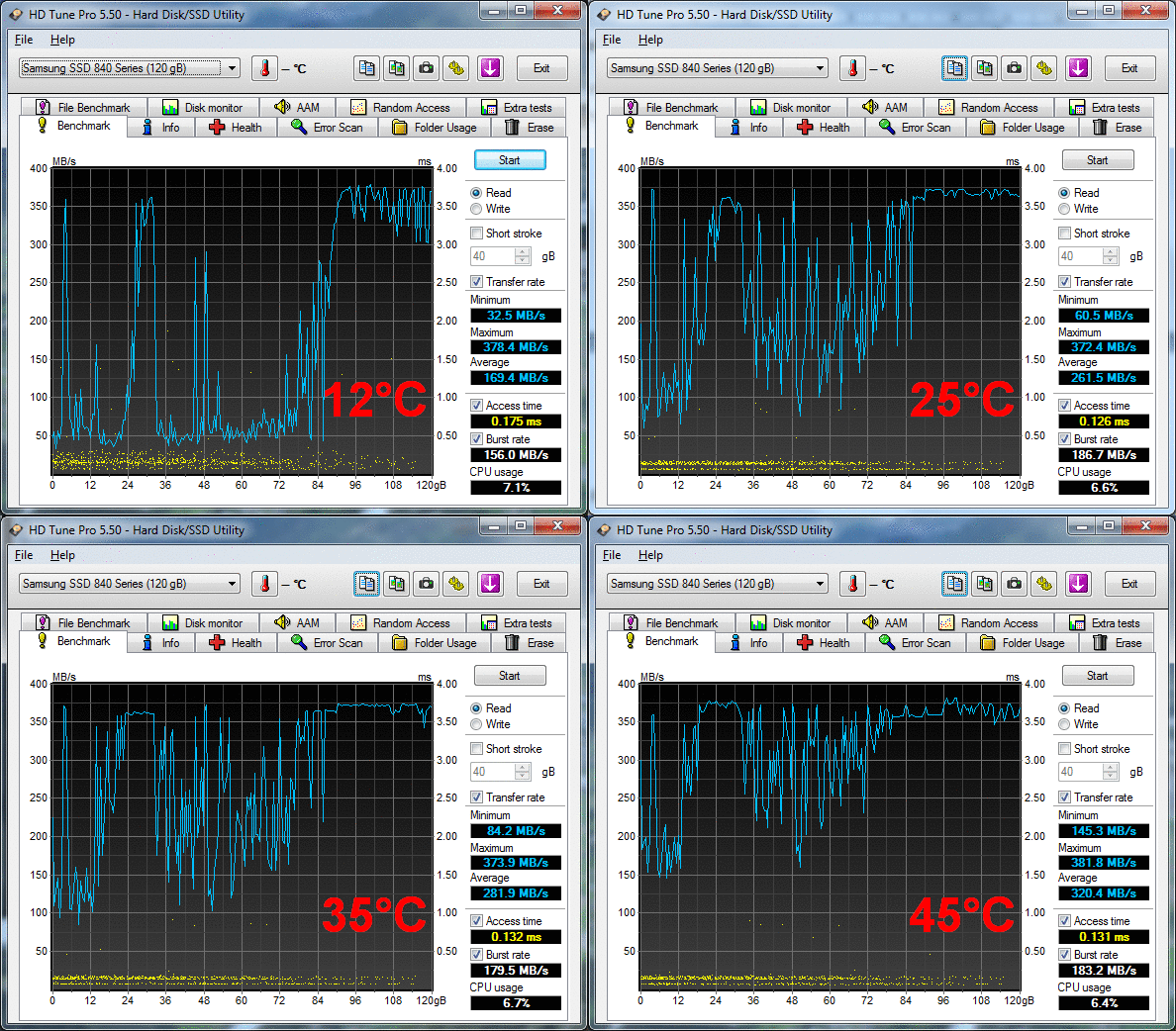
My benchmark results saw wild fluctuations and I could not understand why. As it turns out the drive is also sensitive to heat, and not in the way you might expect: the drive actually works better the hotter it is!

This is not so strange because temperature differences affect the voltage drift in the NAND. Only now we begin to realize just how difficult it must be to get that algorithm right… it’s just a pity that it took Samsung just as long to realize as well.

The data for the graph above was gathered using SSD Read Speed tester when the drive reported that it was 40°C. The graph below loops the previous graph and the same test performed with the drive cooled to 15°C. You can see how the worst-case performance is right down at ~50MB/s, a far cry from the optimal 500MB/s for this drive.
When SSD Performance Goes Awry
It’s entirely possible to presume that while the NAND in my drive performs better with increased temperatures, a different drive might be the total opposite. It’s also been proven by PC Perspective that the drive’s controller will throttle if it becomes too hot, so I would in theory want to cool down the controller, but heat the NAND chips to get optimal performance.
When SSD Performance Goes Awry
 Just like the SSD 840 EVO, there are OEM variants of the standard SSD 840. The Samsung SSD PM841 uses the same 21nm NAND, as does the SSD PM843. Samsung claims these drives do not have the speed degradation issue either, but the data above speaks for itself. We have tested a second SSD 840 in-house that shows the same degradation patterns along with the numerous reports that can be found online.

Dell is not the only OEM using the drives either. The Razer Blade Pro laptop we reviewed recently sports one of these Samsung OEM drives, and honestly "like new" performance is really good. Microsoft also uses them in the Surface Pro 3, and Samsung went as far as releasing a firmware update to fix read degradation, only to pull it later.

Yet another potentially affected product is the Samsung SSD 845DC EVO**, an enterprise drive for server use, specifically suited for and I hope you enjoy irony as much as I do: “suitable for read-intensive applications”. The 845DC ECO uses NAND with the exact same part number as the 840 EVO and PM851: K90KGY8S7M-CCK0. Samsung may have binned the best part of the TLC NAND for use in this drive, so the problem is likely to take a bit longer to show up on it.

Quoting Samsung below, these were the kind of claims the company made when it promoted the use of TLC NAND. In all fairness, we've recommended the drives in our reviews, as have many others, and we happen to be using a handful of them in our systems as well.

    "To top it all off, you can rest assured knowing that your SSD will continue to offer excellent performance throughout its useful lifespan. With its simple upgrade solution and sustained, industry- leading performance, the Samsung SSD 840 is the single best upgrade you can make to your PC."
    Source

    “The 840 Series represents the first consumer SSD to implement 3-bit/cell MLC (also called TLC) technology (...) This is nothing a good firmware algorithm can’t handle, however. Samsung’s 3-bit/cell MLC-based SSD 840 Series, equipped with mandatory OP, will still far outlast the useful life of the hardware it powers.”
    Source

Reliability, as in data loss, has not been put into question. So here’s my open request to Samsung: admit the problem exists in all the affected drives as evidenced in this article and in the countless reports found in this lengthy thread on the Overclockers.net forums and elsewhere online.

As of writing, this single discussion has gathered over 2,770 replies and 345,000 views. Thus far Samsung has decided to ignore the SSD 840 and all the aforementioned variants even though the drives carry 3-year warranties. Samsung, the ball is on your court now...